
Author
Swathi Sugumar
Sr. Product Manager
Pharmaceutical product information is rapidly evolving into a structured digital format – and regulators are actively progressing toward structured digital product information requirements. Here is what ePI means for your regulatory operations, your compliance posture, and why 2026 is the year to act.
A patient picks up a new prescription, unfolds the tissue-thin paper insert, squints at eight-point font across columns of warnings in five languages – and gives up halfway through. They Google it instead.
Now ask: is that insert current? Does it reflect the latest variation your regulatory team submitted six months ago?
The honest answer, in most cases, is: nobody actually knows.
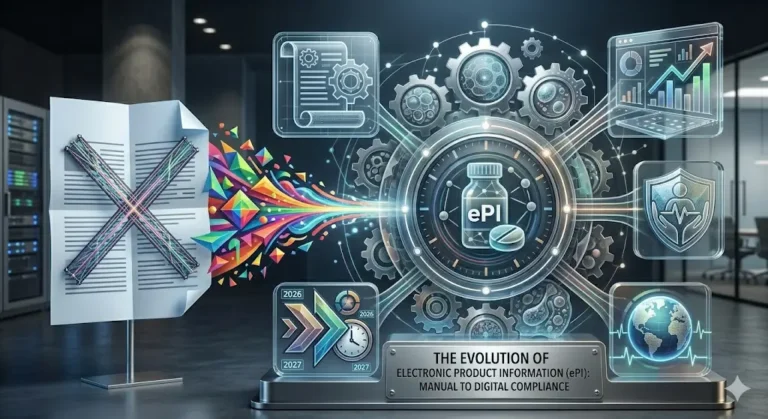
This is the problem that electronic Product Information – ePI – was designed to address. And as of 2026, regulators across multiple markets are accelerating initiatives around structured digital medicinal product information, with phased implementation timelines already emerging.
The current momentum is strongest in Europe, but the shift is global. Jordan has emerged as an early adopter of FHIR-based ePI initiatives. Health Canada has advanced structured XML-based product monograph initiatives. Several other regulatory authorities are actively exploring or developing their own digital product information frameworks. For companies operating across multiple markets, ePI readiness is no longer a single-market compliance consideration.
What Is ePI?
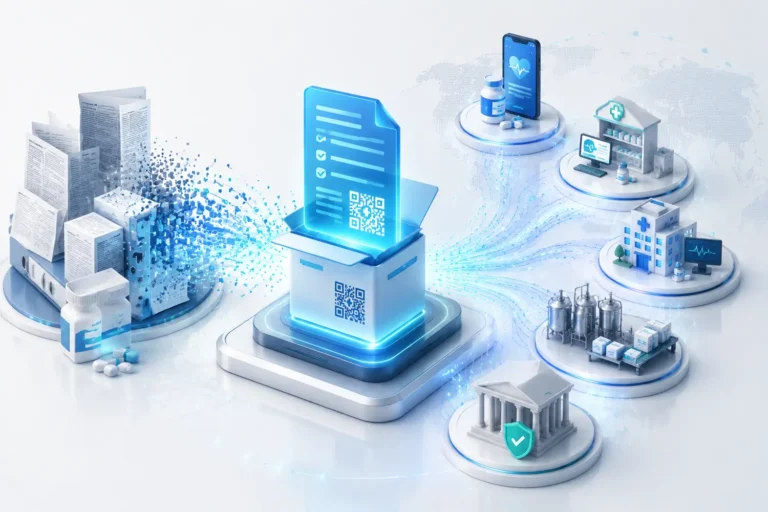
Electronic Product Information, or ePI, is the authorized, statutory product information – prescribing information, patient leaflet and labelling for a medicine – structured in a machine-readable digital format and made available via the web, digital platforms, and electronic healthcare systems.
The Format Is the Point: Why FHIR Changes Everything
ePI is not a PDF, a scanned document, or a QR code linking to a static file.ePI is structured data – think of it less like a document and more like a database your label content lives inside. It is built on HL7 FHIR (Fast Healthcare Interoperability Resources) – the same technical standard that underpins modern electronic health records.
In practice, this means:
- Every section of your product label data becomes a tagged, queryable data field
- Every dosage instruction, contraindication, and warning is individually addressable
- Your label data can be read, verified, and displayed by any connected healthcare system
- Updates propagate in real time – patients and clinicians always access the current approved version
Why Does This Actually Matter for Pharma Companies?
There are three reasons ePI matters – and they operate on very different timescales.
1. Regulatory Compliance – The Immediate Reason
Regulators are progressively defining implementation roadmaps for structured digital product information.
The European Medicines Agency (EMA), for example, has outlined a phased ePI rollout approach that includes:
- Q4 2026 – voluntary ePI activities beginning for vaccines
- H1 2027 – expansion toward oncology products
- H2 2027 onward – broader Centrally Authorized Product (CAP) rollout
- Future state – expected transition toward mandatory adoption under revised pharmaceutical legislation
As global regulatory frameworks continue to evolve, organizations that delay readiness activities may face compressed timelines, higher remediation costs, and operational disruption
2. Operational Efficiency – The Business Reason
Managing product information across Word documents, PDFs, SPL files, and IDMP submissions across multiple markets is expensive and error-prone. A single label variation today means source content pulled from Word, reformatted for PDF, manually reconciled against SPL and IDMP filings – repeated across every market. With FHIR-structured ePI, that update happens once, propagates consistently, and is auditable at every step.
3. Patient Safety – The Reason That Outlasts Deadlines
Outdated package inserts are a documented patient safety risk. When a variation is approved but the paper insert is six months old, patients may act on incorrect dosage information or superseded contraindications. FHIR ePI closes that gap – the approved, current version is always what patients and clinicians access.
Where Do You Start?
The most important first step is understanding your organization’s current readiness position:
- against evolving regulatory expectations
- against current interoperability standards
- and against the complexity of your own label portfolio
A successful ePI readiness programme typically begins with:
- A complete assessment of existing label and product information assets
- Identification of compliance and interoperability gaps
- Evaluation of structured content and FHIR conversion readiness to build a roadmap
- A phased implementation roadmap aligned to product and market priorities
- A scalable platform and governance strategy
The Label Landscape Is Changing. The Question Is Whether You’re Ready.
ePI is not a technology project. It is a regulatory transformation that touches every label in your portfolio, every market you operate in, and every team responsible for product information – from authoring to submission to post-approval management.
Pharma companies that invest in the right architecture and expertise now will have a genuine competitive advantage: faster variations, lower regulatory overhead, and a compliance posture that scales as mandates expand globally. The ones that wait will be scrambling.
Ready to Assess Your ePI Readiness?
Understanding where your organization stands today is the first step toward building a scalable and compliant digital product information strategy.