

Author
Swathi Sugumar
Sr. Product Manager
Executive Summary
A leading global pharmaceutical manufacturer operating across 100+ markets faced a compounding compliance risk: barcode inconsistencies, GS1 validation failures, and increasingly fragmented quality assurance processes were hindering product release timelines and regulatory standing. The organization partnered to design and deploy a centralized, cloud-based GS1 Validation engineered for enterprise-scale pharmaceutical operations.
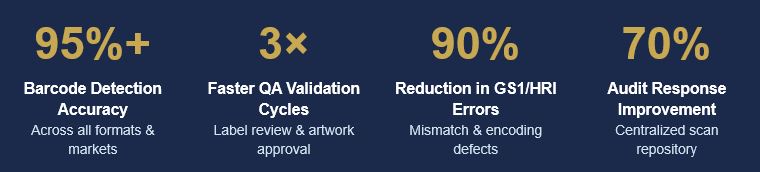
This case study documents the strategic rationale, diagnostic findings, solution architecture, and realized business outcomes of this transformation—demonstrating how systematic investment in digital quality infrastructure creates durable competitive advantage in global pharmaceutical manufacturing.
1. Strategic Context & Business Imperative
Industry Landscape
The global pharmaceutical supply chain operates under an increasingly complex and unforgiving regulatory environment. Mandatory traceability frameworks—including the U.S. Drug Supply Chain Security Act (DSCSA), the European Union Falsified Medicines Directive (EU FMD), and GS1 global encoding standards—have transformed barcode label integrity from a peripheral quality concern into a mission-critical compliance function.
For manufacturers operating at scale, the implications are profound. A single mislabeled product entering the supply chain can trigger batch recalls, regulatory enforcement actions, and reputational damage that far exceeds the cost of the underlying defect. As serialization mandates expand globally, the ability to validate barcodes with precision and speed has become a direct determinant of market access and operational agility.
Organization
The client is a globally integrated pharmaceutical manufacturer with a commercial presence in more than 100 markets, supported by a network of owned manufacturing plants and third-party Contract Manufacturing Organizations (CMOs). The organization’s quality assurance function was operating at an inflection point: volume growth and portfolio complexity had outpaced the capacity of existing manual validation processes, creating systemic risk across artwork approval, batch release, and regulatory readiness.
2. Problem Diagnosis: Root Causes
A structured diagnostic assessment identified three interconnected factors
1. Data-Layer Encoding Defects — Missing FNC1 codes, invalid Application Identifiers, incorrect GTIN check digits, and improperly encoded expiry/serial/batch data were propagating silently through artwork approval.
2. HRI Interpretation Failures — HRI text mismatching encoded values and OCR failures on low-contrast or camera glare created confusion in regulatory submissions.
3. Operational & Governance Gaps — No unified validation framework existed. Each market applied its own interpretation of GS1 rules, with no central audit trail and QA bandwidth consumed by reactive investigation rather than proactive quality management.
The cumulative effect was not just operational drag – it was unquantified regulatory exposure at scale.
“We had validation processes running differently across every market and every CMO. The risk wasn’t just operational — it was regulatory. We needed one system that everyone trusted.”
— Director, Supply Chain | Global Pharmaceutical Manufacturer
3. Solution Architecture
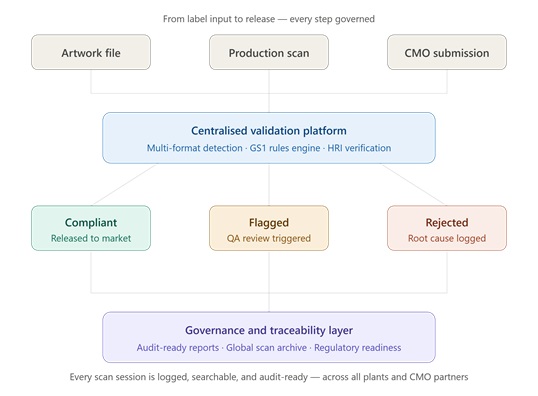
The solution mandate was clear: replace fragmented, manual validation with a single enterprise system that could enforce GS1 standards with consistency, speed, and full auditability.
Overview
A cloud-based GS1 Validation solution with
- Multi-format detection (GS1-128, DataMatrix, QR, EAN/UPC)
- Real-time, rules-based GS1 SDK validation engine
- OCR-powered HRI extraction and encoded-value matching
- Automated error codes with root-cause categorization
- Batch processing up to 10 images per session
- AD-SSO web and mobile interface with on-floor camera capture
- Structured PDF compliance reports and historical scan archive
4. Implementation Methodology
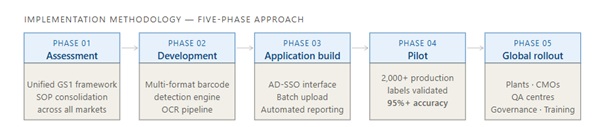
Implementation followed a disciplined five-phase methodology, sequenced to deliver early validation signal while building toward full-scale global deployment. Each phase was designed to be iterative, with quality gates governing progression.
5. Realized Outcomes & Business Impact
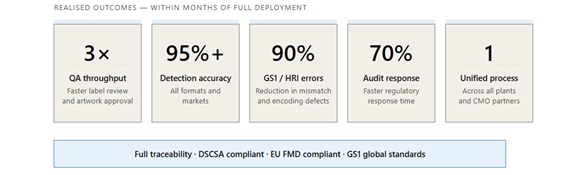
Within months of full deployment delivered measurable, enterprise-wide impact across critical performance dimensions.
6. Strategic Value Creation
This barcode validation has been reframed from a reactive compliance activity into a proactive competitive capability
- Compliance Risk Mitigation
Reduces compliance risks by eliminating manual validation errors, minimizing mislabeling, regulatory actions, and product recalls. - Accelerated Time-to-Market
Speeds up artwork approval and defect resolution, enabling faster product launches. - Operating Cost Reduction
Automates verification, reducing rework, investigations, and operational costs while improving efficiency. - Enterprise Governance Standardization
Establishes a unified validation framework across plants, CMOs and markets for consistent global compliance. - Digital Transformation Enablement
Builds the foundation for serialization, end-to-end traceability, and supporting future digital initiatives
Conclusion
The GS1 Validation Modernization initiative represents a defining moment in this organization’s digital quality transformation. By replacing fragmented, manual processes with a purpose-built, enterprise-scale validation standard, the company has not merely solved an operational problem—it has established a new foundation for how quality is governed, measured, and continuously improved across its global manufacturing network.
Ready to eliminate GS1 validation risk across your manufacturing network?
Our team works with global pharmaceutical manufacturers to deploy enterprise-scale barcode validation — from pilot to full phased rollout.
→ Request the full implementation brief | → Book a 20-minute walkthrough