

|
Author |
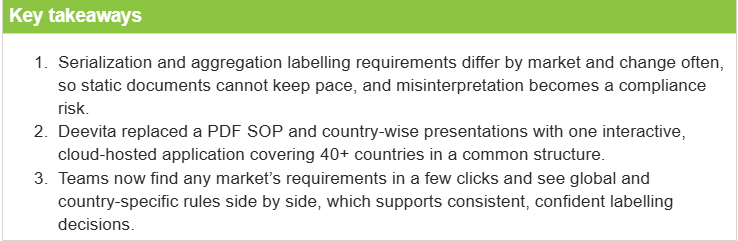
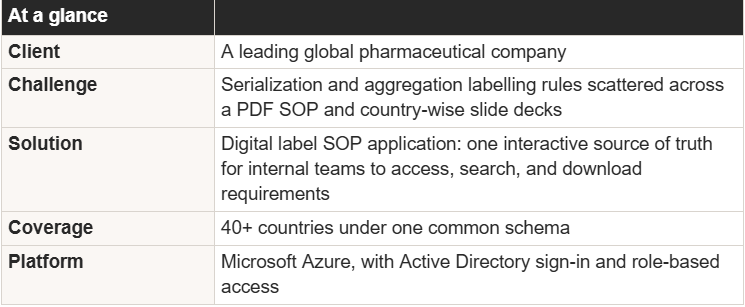
A global pharmaceutical manufacturer managed its serialization and aggregation labelling requirements for markets worldwide through one SOP in PDF format, backed by country-wise PowerPoint presentations. Packaging, labelling and supply chain teams had to search long documents to find which rules applied to a market, then compare the global standard against country-specific rules by hand.
The process was slow and depended on how each reader interpreted the requirements. That led to inconsistent application of standards and a higher risk of labelling non-compliance. This case study covers the challenge, the digital labelling solution Deevita built, and what changed for the teams using it.
Why serialization and aggregation labelling requirements are hard to manage
Serialization and aggregation rules have expanded rapidly across the globe. Each market defines its own requirements for unique identifiers, aggregation across packaging levels, participant obligations, and reporting to national systems, and those rules keep evolving.
In the EU, for example, medicines covered by the falsified medicines framework carry a unique identifier and an anti-tampering device on the outer packaging, and GS1 standards are widely used to identify products down to the batch or serial number.
For a global manufacturer, one product may need to meet different labelling requirements at the sales unit, bundle, case, shipper and pallet levels, depending on where it ships. As portfolios and market footprints grow, knowing quickly and accurately what a market requires, and how it differs from the global standard, becomes a compliance and speed-to-market issue, not just a documentation task.
Three root causes behind the problem
- Fragmented, document-bound knowledge. Global and market-specific rules sat in a PDF SOP and separate country presentations. There was no single place to see everything that applied to one market, so users cross-referenced files and relied on their own interpretation.
- Slow, error-prone lookup. Finding the regulation overview, participant obligations, packaging-level attributes and label content for a market meant searching long documents by hand. Comparing global and country rules took time and raised the risk of missed or misread requirements.
- No consistent structure across markets. Each country was documented in its own format and level of detail, which made side-by-side comparison, onboarding new markets and applying updates consistently difficult.
The result was more than lost time. The regulatory knowledge base was hard to trust, maintain and scale as the number of serialized markets grew.
The Solution: A digital label SOP application on Azure
Deevita built a digital labelling application that turns the static SOP and country documents into one interactive source of truth. The goal was a fast, self-service way for global packaging, labelling and supply chain teams to understand the serialization and aggregation requirements for any market, without depending on long documents or individual interpretation. It sits alongside Deevita’s wider pharma labelling and GS1 compliance applications.
What teams can do
- See requirements instantly. View the regulatory status and requirements for any region, cluster or country in seconds, not hours.
- Compare global and local rules. Global standards and country-specific rules appear together, so differences are clear and nothing is missed.
- Get the complete picture. Each market’s regulatory obligations, supply chain responsibilities and reporting expectations sit in one place.
- Follow labelling guidance at every packaging level. Consistent guidance from the sales unit up to the pallet reduces labelling errors and rework.
- Work from one interpretation. Every user sees the same requirements in the same format.
How it is built
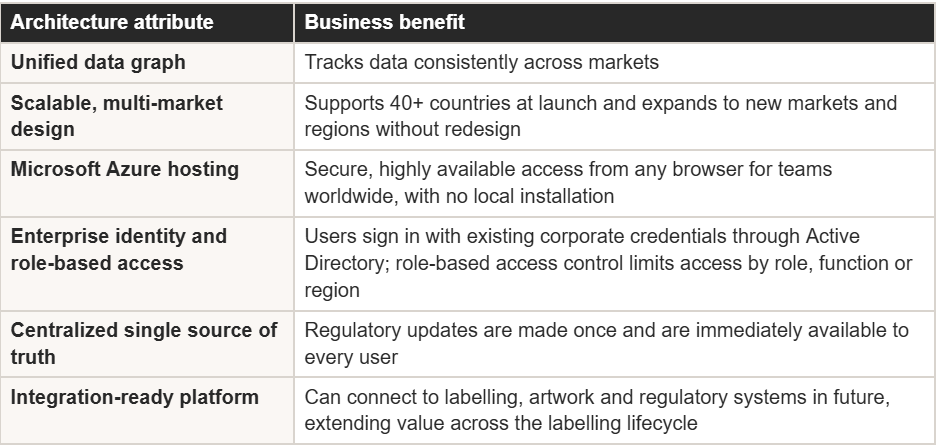
The application uses a cloud-native architecture designed to grow with the company’s footprint, built on Azure native development practices.
Results: what changed after deployment
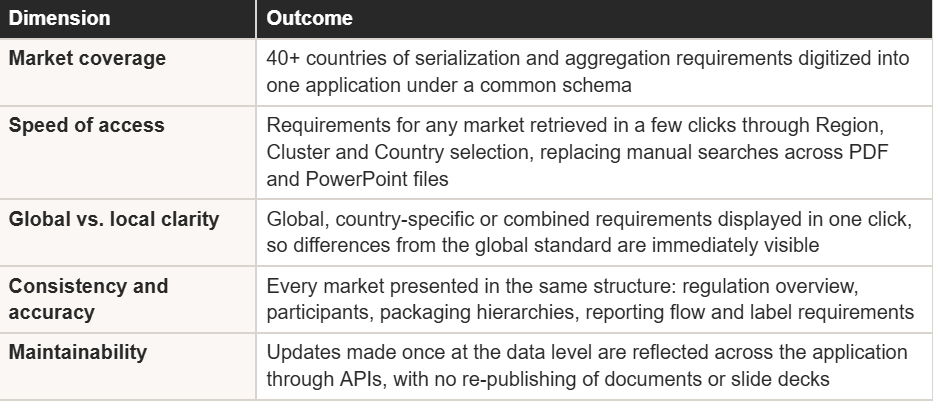
After deployment, the application delivered measurable impact on coverage, speed and consistency:
Strategic value for packaging, labelling and supply chain teams
The project was reframed from a document conversion exercise into a lasting regulatory knowledge capability:
- A single source of truth. SOP and country book content now sits in one governed, central database that all teams reference.
- Faster, more confident decisions. Packaging, artwork, labelling and supply chain teams see what each market requires at every packaging level.
- A consistent global standard. The common data graph describes every country the same way, which makes cross-market comparison simple.
- Scalable onboarding of new markets. New countries and regulatory changes are added as data within the existing schema, not as new documents.
- A base for regulatory intelligence. The structured, API-enabled, Azure-hosted platform is ready to support change tracking, integration with labelling and artwork systems, and advanced search.
Frequently asked questions
1. What are serialization and aggregation labelling requirements?
They are the rules each market sets for unique identifiers on packs, aggregation across packaging levels (sales unit, bundle, case, shipper and pallet), participant obligations, and reporting to national systems. They differ by country and keep changing.
2. Why are PDF SOPs and slide decks hard to use for global labelling requirements?
Requirements end up fragmented across files, lookups are slow and manual, and each country is documented in its own format. Teams then rely on their own interpretation, which raises the risk of inconsistent application.
3. What is a digital label SOP application?
It is an interactive application that turns a static SOP and country-wise documents into one source of truth. Users select a region, cluster or country and see global, country-specific or combined requirements in the same structure.
4. How does the application handle regulatory changes and new markets?
Updates are made once at the data level and reflected across the application through APIs. New countries are added as data within the existing schema, not as new documents.
5. Can it connect to other labelling or regulatory systems?
The platform is integration-ready and can connect to labelling, artwork and regulatory systems in future, extending its value across the labelling lifecycle.
Conclusion
The digital labelling solution is more than a document conversion. It replaced static, fragmented SOP and country-wise documents with a structured, interactive, cloud-hosted platform that delivers global and market-specific serialization and aggregation labelling requirements on demand. With a common data graph, API-driven services and a market-driven user experience, the organization gained a single source of truth for 40+ countries and a scalable foundation for managing regulatory change.
Related: How a global pharmaceutical leader transformed label accuracy, compliance and supply chain throughput · more from Pharma & Life Sciences.
Ready to simplify regulatory labelling in your organization?
Talk to our team about digital labelling and compliance applications:
Ask Our Experts → (sales@deevita.com) (or) Contact Us