Author
Swathi Sugumar
Sr. Product Manager
Why Medicinal Information Can No Longer Afford to Stay Static?
Every approved medicine carries a body of critical information — dosing instructions, contraindications, warnings, and patient guidance. For decades, this information has lived in paper leaflets, static PDFs, and siloed databases: arriving late, going out of date, and rarely available at the precise moment it is needed.
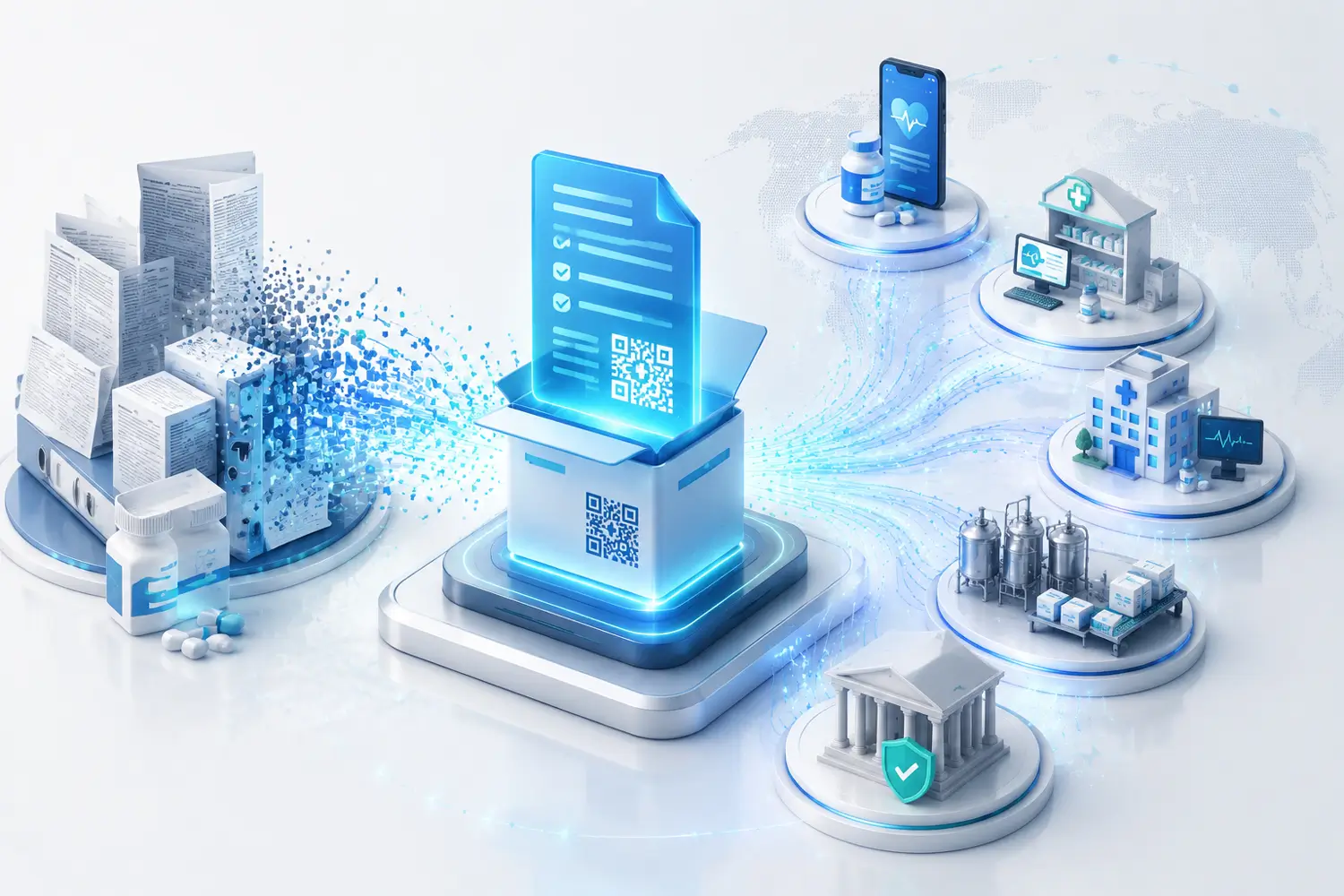
Electronic Product Information (ePI) changes this. Built on the HL7 FHIR standard, ePI transforms static product labels into structured, machine-readable, interoperable content — authored once, approved by regulators, and delivered in real time to every stakeholder across the healthcare ecosystem. It is the single source of truth for medicinal product information.
What Makes ePI Different?
Unlike a scanned PDF or a Word document formatted for print, ePI is structured XML — each section (dosing, contraindications, warnings, storage) is individually queryable and integrable into downstream systems. Key properties include:
- Single source of truth: One regulator-approved version, maintained in real time
- Interoperability: Consumed natively by EHRs, pharmacy systems, patient apps, and regulatory portals
- Real-time updates: Label changes propagate in near real time — no more waiting on the next print cycle
- Accessibility: Rendered in audio, large print, plain language, or any user’s preferred language
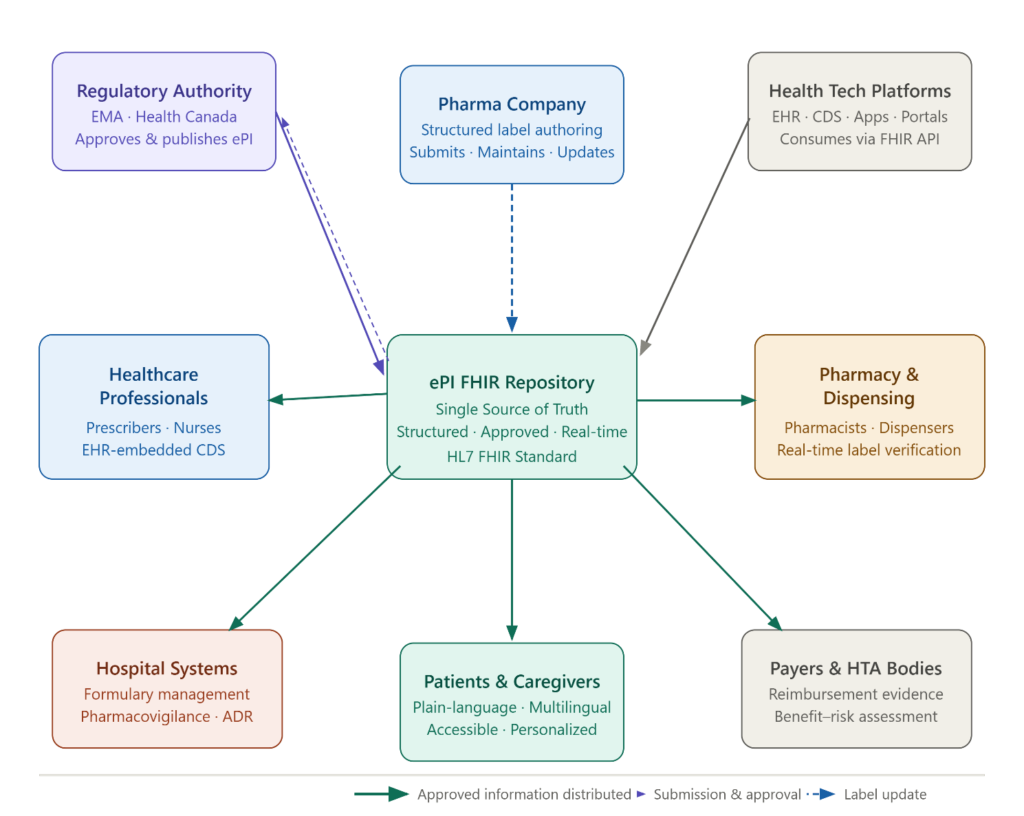
ePI in Action: Across the Ecosystem
WHERE ePI CREATES VALUE – AND FOR WHOM
Five stakeholder groups. One source of truth. Here is what changes for each.
01 PATIENTS & CAREGIVERS
The right information, in the right language, at the right moment.
Today’s medication leaflets are static: one format, one language, printed once and rarely updated. With ePI integrated into pharmacy apps and patient portals, approved medication information reaches them in plain language, their preferred language, and an accessible format – audio, large text display or visual guide. When the label changes, their guide updates automatically.
02 PHARMACISTS & DISPENSING NETWORKS
Approved intelligence embedded in the dispensing workflow – not a tab away.
Pharmacists currently verify labels against databases maintained by third parties, updated on cycles that lag regulatory approvals by weeks or months. ePI delivers structured contraindication, dosing, and interaction data via FHIR API directly into dispensing systems. Label changes can propagate within hours of regulatory approval – to every branch, automatically. The pharmacist stops chasing information. The information comes to them.
03 PRESCRIBERS & CLINICAL TEAMS
Clinical decision support grounded in the current approved label — not last quarter’s.
EHR-embedded CDS tools are only as good as the data that feeds them. When that data comes from ePI – structured, current, regulator-approved – prescribers get inline guidance on approved dosing ranges, licensed indications, and renal or hepatic adjustments at the moment of prescribing. Hospital formulary teams receive automated alerts when a label change affects a formulary product. The governance workflow triggers itself.
04 PHARMACEUTICAL COMPANIES
Author once. Distribute everywhere. Update instantly.
Global labeling operations currently manage hundreds of documents across dozens of markets – authoring, translating, reformatting, distributing, and monitoring for gaps. ePI’s structured modular architecture allows content to be authored once and adapted for each market’s regulatory requirements. FHIR-compliant submissions accelerate regulatory review. When a label update is approved, the distribution layer pushes it to every connected system automatically – replacing a manual process that takes weeks with one that takes hours.
05 REGULATORY AUTHORITIES
From document archive to living information infrastructure.
Structured ePI submissions can be validated programmatically – reducing administrative review burden and catching conformance errors before they reach an assessor’s desk. Public FHIR repositories let hospital systems, national prescribing databases, and patient platforms subscribe to current approved content in real time. Regulators stop being the last step in a slow distribution chain. They become the source of a fast one.
ePI OUTCOMES AT A GLANCE
|
Stakeholder |
What ePI enables |
|---|---|
|
Patient |
Receives current, accessible, plain-language medication information in real time |
|
Pharmacist |
Dispenses against live approved label data — interaction alerts grounded in FHIR content |
|
Prescriber |
Inline CDS at the point of prescribing, tied to the current approved indication and dosing |
|
Pharma |
Single structured source drives all markets, all channels, all updates – automatically |
|
Regulator |
Structured submissions, automated validation, live public label repository |
THREE THINGS THAT MAKE THIS URGENT NOW
01
Regulatory mandates are landing
The voluntary rollout has a defined start date – vaccines and oncology products lead the way in 2026. Mandatory status follows. The voluntary window is closing.
02
AI needs structured labels
LLMs and CDS engines can only reason over approved content if that content is structured and machine readable. ePI is the data layer that makes clinical AI trustworthy.
03
Patients expect digital access
Post-pandemic patients expect to access their medication information the same way they access everything else – digitally, immediately, in their language.
One Source. Every Touchpoint.
The fragmentation of medicinal product information is a structural patient safety risk. ePI addresses this at the root – making approved information structured, interoperable, and continuously current from a single regulatory source of truth.
For pharma companies, it accelerates label lifecycle management. For regulators, it enables digital-first submission and distribution. For clinicians and pharmacists, it embeds approved intelligence into care workflows. For patients, it delivers the right information at the right moment. Organizations that invest in ePI capability now will lead in a connected, safer healthcare ecosystem.
Ready to modernize your product information strategy?
Start with a focused ePI readiness assessment – a short, scoped engagement to map your current product information landscape against the ePI rollout timeline and identify your practical next step.