Author
Swathi Sugumar
Sr. Product Manager
Converting hundreds of legacy labels to FHIR-structured ePI manually was never going to work against a regulatory deadline. Here is what AI changes — and what it does not.
Most pharmaceutical companies approaching ePI have the same instinct: convert the existing labels first, figure out authoring later. It is a logical sequence. It is also the reason most ePI programmes end up solving half the problem.
Converting a legacy label to FHIR-structured ePI and authoring a new one from scratch are not the same challenge. They share the same destination — a compliant, structured, regulator-approved ePI asset — but they start from completely different places. One starts with a document that already exists. The other starts with a blank page that needs to become FHIR-native from the first word.
AI changes both. Not in the same way. And not with the same implications for the regulatory writer doing the work. What follows is an honest look at what that transformation actually involves — across conversion, across authoring, and across the boundary where AI stops and human accountability begins.
The Scale of the Problem
A regulatory writer opens a legacy SmPC. Reads it in full. Identifies each section. Maps it to the corresponding FHIR resource element. Authors the structured content from scratch. Submits for QC. Iterates. Signs off.
One label. One writer. Multiply that across an estate spanning hundreds of products, multiple markets, and several language variants — against regulatory timelines moving from voluntary to mandatory — and the constraint becomes clear.
This is not a resourcing problem that more writers solves. It is a process problem.
Where AI Changes the Equation
AI does not replace the regulatory writer. It removes the part of their job that was never a good use of their expertise — the reading, the section identification, the structural mapping. What remains is the work only a regulatory writer can do: reviewing the output, applying clinical judgement, and signing off with accountability.
Regulatory teams have heard AI promises before. What makes ePI conversion different is not the sophistication of the technology. It is the specificity of the problem — a defined input, a defined output standard, a defined deadline. AI performs best when the task has clear parameters. ePI conversion and authoring, more than almost any other regulatory workflow, fit that description.
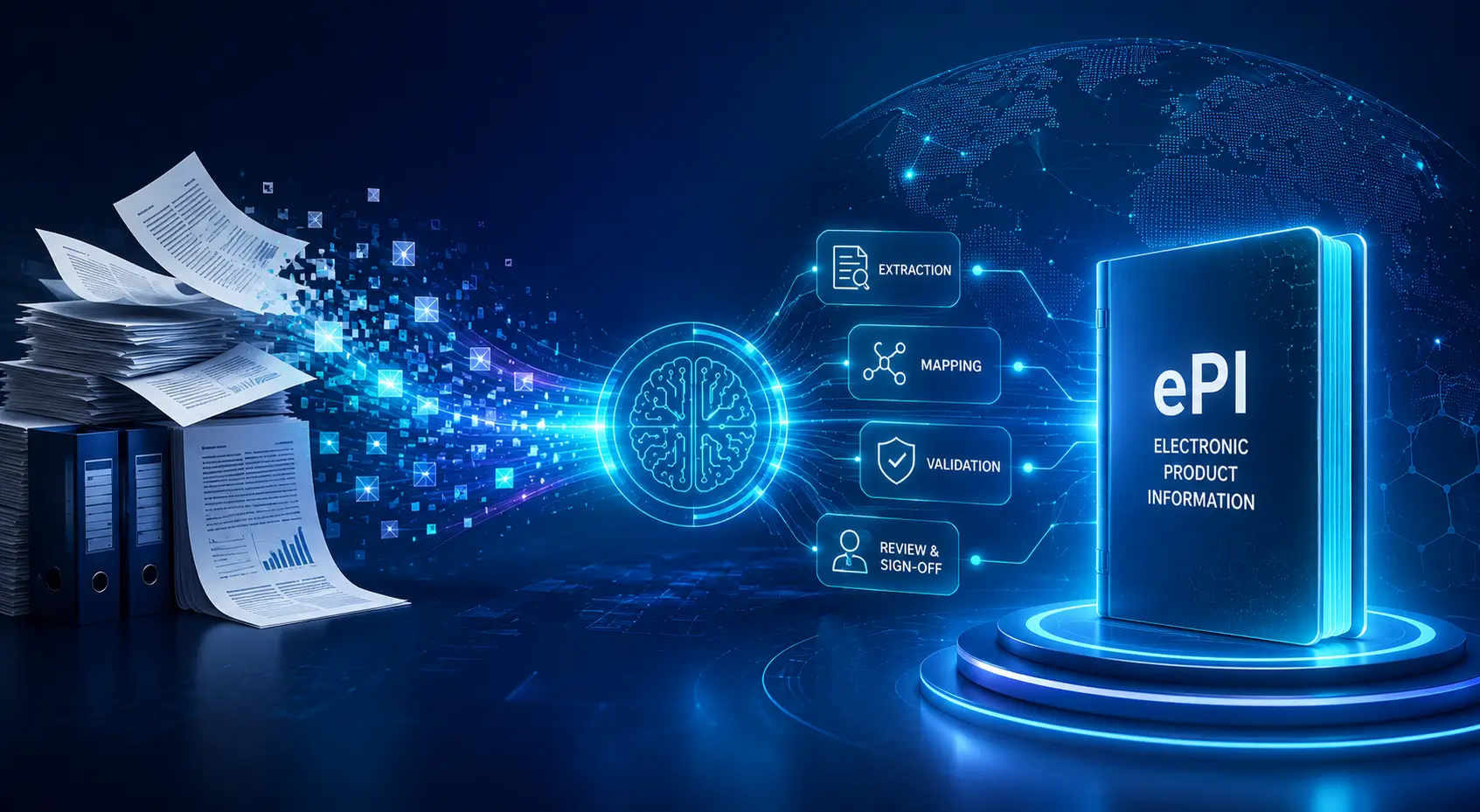
That shift happens across five stages
Before AI. After AI.
Here is what changes at each stage — whether you are converting a legacy label or authoring a new one
|
BEFORE AI |
AFTER AI |
|
|
Extraction |
Writer reads the full legacy label. Manually identifies each section across varied formats, headers, and document ages. Time-intensive and format-dependent. |
AI reads the document and identifies all sections — regardless of format, age, or header convention. The writer reviews the output rather than producing it. |
|
FHIR Mapping |
Writer maps each section to the FHIR resource element from memory and reference documents. Complex or non-standard structures require senior regulatory judgement. |
AI maps extracted content to current FHIR ePI IG elements with contextual understanding — handling complex structures that rules-based systems routinely miss. |
|
Validation |
Validation against the FHIR EPI IG is a manual check — often done at submission point, when conformance errors are expensive and time is short. |
Platform validates against the current live IG at point of generation. Conformance errors caught before they reach submission, not after. |
|
Review & Sign-off |
Writer is the author, QC check, and sign-off on the same document. Regulatory expertise applied uniformly across the entire label. |
Writer reviews structured output and applies regulatory judgement where it genuinely matters. Expertise focused on the sections that need it most. |
The regulatory writer did not disappear. Their role changed.
Beyond the Backlog
Conversion addresses what already exists. Authoring addresses everything that comes after — every new label, every variation, every post-approval change.
AI-powered guided authoring means FHIR-native ePI is the natural output of the authoring process, not a conversion step that happens afterwards. The regulatory writer works within an IG-aligned workflow from the first word — producing structured, compliant content rather than reformatting it after the fact.
For organisations thinking beyond the immediate deadline, this is where the long-term value lives. The conversion programme is finite. The authoring capability is permanent.
What AI Does Not Change
Task allocation is one thing. Accountability is another. AI accelerates extraction, mapping, structuring, and validation. It does not carry regulatory accountability. It does not replace the GxP audit trail. It does not approve content. The regulatory writer who reviews and signs off carries that responsibility. The validated workflow that produced the output carries that responsibility. The audit trail that documents every step is what a regulator looks at.
Platforms that are transparent about this boundary are the ones worth evaluating seriously. AI inside a validated, GxP-compliant workflow is a genuine programme accelerator. AI presented as a submission-ready output engine — without that validated workflow underneath it — is a compliance risk that surfaces at the worst possible moment: close to a deadline, with limited options.
Questions Worth Asking Your Platform Vendor
These four questions separate genuine capability from a well-produced demo. Ask them before any programme commitment:
What This Means Right Now
The organisations that will meet their ePI deadlines without a crisis are not the ones with the most sophisticated AI. They are the ones that understood early enough that conversion and authoring are workflow design problems — and that AI, deployed correctly inside a validated workflow, is what makes those workflows scale. The window to pilot properly, validate outputs, and build authoring capability that holds beyond the conversion programme closes as regulatory deadlines approach.
The Regulatory Direction Is Global
EMA’s voluntary go-live for vaccines launched in Q3 2026. Oncology products enter the voluntary implementation phase in Q4 2026 — the deadline is weeks away, not months. Mandatory requirements for newly authorised medicines follow once the new EU pharmaceutical legislation formally enters into application. Health Canada has signalled its own digital product information direction. Regulatory bodies across Asia-Pacific are tracking the EMA model closely.
The organisations building AI-enabled conversion and authoring capability now are doing so while they still have time to design the workflow properly, pilot on real labels, and sequence their estate intelligently. The ones that wait will build the same capability under deadline pressure — with fewer options, higher cost, and less room to course-correct.
AI gives back time. But only if you give it time to work with.
See what AI-enabled conversion and authoring looks like on your labels – not ours.
Deevita’s ePI Pathfinder programme runs a validated AI-assisted conversion pilot on labels from your own estate – including the complex ones – scopes your full conversion effort against your regulatory deadline profile, and gives your leadership a programme plan grounded in what your labels actually require.
Already past the scoping stage? Ask us to demonstrate Smart Conversion, Guided Authoring, and Built-In ePI Validation on a label from your own estate.
Book a Pathfinder conversation: epi@deevita.com